My dear ones, I want you to pause for a moment and take a gentle breath. Inhale deeply, and as you exhale, I invite you to ask yourself a question: Who are you, beyond what you have endured?
For so many of us, especially as Black women navigating a world that has often demanded our resilience above all else, this question can feel startling.
We are so accustomed to defining ourselves by our strength, our ability to withstand, our capacity to survive. We wear the label of ‘survivor’ as a badge of honour, and rightly so. It speaks to a profound power that resides within our spirit.
Yet, there is a subtle and powerful distinction between honouring our journey and allowing our identity to be tethered exclusively to our trauma. When our sense of self is built upon a foundation of pain, we live in a state of perpetual survival.
We become hyper-vigilant, always anticipating the next threat. We may find ourselves repeating cycles of people-pleasing or self-sabotage, not because we are broken, but because our nervous system is wired for a battle that may no longer be present.
This is what I call a trauma-based identity. It is a way of being where the past dictates the present, and the future feels like an echo of what has already happened.
But what if I told you that you are so much more than a survivor? What if I told you that within you lies a sovereign being, a queen, an elder-in-training, whose story is one of purpose, joy, and profound peace?
Moving from a life of survival to one of sovereignty is not about forgetting the past. It is about integrating its lessons so that you are no longer defined by its wounds. This sacred journey is a homecoming, and it unfolds in three powerful phases: The Remembering, The Unveiling, and The Reclaiming.
The Heavy Cloak of Survival
A trauma-based identity is like wearing a heavy cloak, one passed down through generations. It feels familiar, even protective, but it restricts our movement and obscures our light.
This is not merely an individual experience; it is a collective one. The echoes of historical and intergenerational trauma live within our DNA, shaping how we respond to the world.
The pioneering researcher Dr. Joy DeGruy, in her work on Post Traumatic Slave Syndrome, illuminates how centuries of chattel slavery and systemic racism have resulted in adaptive behaviours that, while once essential for survival, can be detrimental to our wellbeing today.
These can manifest as a persistent feeling of being unseen, a deep-seated mistrust of institutions (and sometimes each other), and the immense pressure to embody the trope of the “Strong Black Woman” who feels everything but shows nothing.
This pressure isolates us, convincing us that vulnerability is a weakness rather than a gateway to authentic connection and healing.
Living this way is exhausting. It keeps us in a state of high alert, what experts call a dysregulated nervous system. We might struggle with anxiety, chronic fatigue, or an inability to rest, because on a subconscious level, we believe it is not safe to let our guard down. We see the world through the lens of potential harm, rather than potential joy.
Recognizing this is the first step toward freedom. This cloak is not you. It is a protective garment you were given, one your ancestors may have worn out of necessity. But you now have the power, and the divine right, to gently lay it down and step into the warmth of your own light.
The Remembering: Reconnecting with Your True Essence
The journey back to your sovereign self begins with The Remembering. This is the sacred process of looking beyond the timeline of trauma to connect with the truth of who you are, and who your people have always been.
Before the pain, before the struggle, there was wholeness. There was wisdom, tradition, and a deep connection to Spirit and Earth.
The Remembering is an act of spiritual archaeology. It is about gently digging beneath the layers of conditioning to uncover the treasures of your lineage. This is not about bypassing pain, but about building a stronger foundation of selfhood from which to heal it.
How can you begin this process?
- Cultivate Curiosity: Ask questions. Talk to your elders if you are able. What stories did they hear as children? What foods did they eat? What songs did they sing? Every small detail is a golden thread leading you back to your roots. If direct connection is not possible, let your curiosity guide you toward the history, cosmology, and traditions of your ancestral lands.
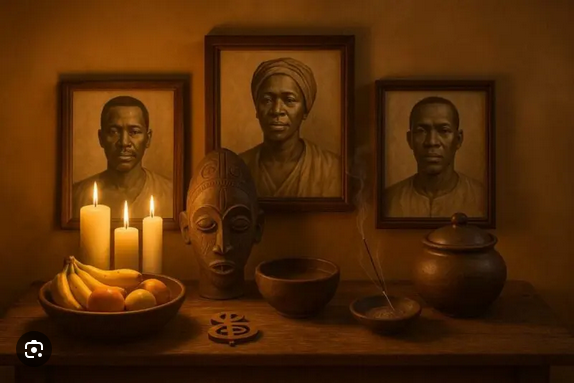
- Create a Sacred Space: Designate a small corner of your home as an altar or a sanctuary.2 It does not need to be elaborate. A candle, a glass of water, a photo of an ancestor, or an object from nature can serve as a focal point. This space is an invitation for your spirit and the spirits of your benevolent ancestors to commune with you. It is a physical declaration that your inner life matters.
- Listen to Your Body: Your body is an archive of ancestral memory. Practices like gentle stretching, dancing to the rhythms of your heart, or simply sitting in silence and noticing your breath can unlock cellular wisdom. Your body remembers what your mind may have been taught to forget.
- Connect with Nature: Our ancestors lived in deep relationship with the land. Spending time in nature, whether it is a local park or your own back garden, helps to regulate your nervous system and reconnect you to the timeless cycles of life, death, and rebirth. Feel the earth beneath your feet and remember that you belong to this world.
The Remembering is a gentle, compassionate phase. It is about rediscovering the vibrant, powerful soul that has been waiting patiently beneath the cloak of survival.
The Unveiling: Facing the Shadows with Compassion
Once you have begun to reconnect with your true essence, you will have the spiritual fortitude to begin The Unveiling. This phase is where we turn to face the patterns and wounds of our trauma-based identity, not with judgement, but with profound compassion. It is the process of shining a loving light into the shadows.
As the renowned psychiatrist Bessel van der Kolk explains in his seminal work, The Body Keeps the Score, trauma is not just stored in our minds as memory; it is held in our bodies. This is why we cannot simply “think” our way out of it.
The Unveiling requires us to feel, to process, and to release these stored energies. It involves courageously examining the beliefs and behaviours that have kept us small.
This is the work of identifying the weeds in our spiritual garden. We ask ourselves:
- Where in my life do I feel powerless?
- What stories do I tell myself about my worth?
- What fears are holding me back from my purpose?
- How has the “strong Black woman” narrative stopped me from asking for help?
The Unveiling is not meant to be a solitary journey. This is where the support of a trusted community, a spiritual mentor, or a therapist becomes invaluable. In a safe and held space, we can give voice to our pain without being consumed by it.
We can perform rituals of release, such as writing down our fears and safely burning the paper, or using sound healing to move stagnant energy from the body.4
This is sacred work. It is the moment we look at the parts of ourselves we have hidden away and say, “I see you. I honour your role in my protection. And now, I release you with love.”
The Reclaiming: Stepping into Your Sovereignty
After Remembering our truth and Unveiling our wounds, we arrive at the most empowering phase: The Reclaiming. This is the conscious and deliberate act of authoring a new story. It is where you move from being a passive character in a story written by trauma to the sovereign author of your own life.
Sovereignty is the embodiment of your divine truth. It is the deep, inner knowing that you are whole, worthy, and guided. It is living in alignment with your soul’s purpose, not the expectations of others or the fears of the past. It feels like calm confidence, clear boundaries, and a profound sense of peace.
The Reclaiming involves several key actions:
- Redefining Your Narrative: You consciously choose the story you tell about yourself. Your past is a chapter, not the entire book. You begin to define yourself by your gifts, your dreams, your wisdom, and your capacity for joy.
- Embodying Ancestral Strengths: You call upon the resilience, creativity, and wisdom of your lineage not as a burden, but as a source of power. You are the realisation of their prayers, and you carry their legacy forward with grace.
- Setting Soulful Boundaries: You learn to say “no” with love and clarity. You protect your energy as a sacred resource, understanding that you cannot pour from an empty vessel. Your peace becomes non-negotiable.
- Living with Purpose: You begin to make choices, big and small, that are aligned with your deepest values. You start the project, you take the journey, you speak your truth, you share your gifts. You allow your inner light to guide your path.
This transformation is profound. It is the difference between reacting to life and co-creating it with Spirit. It is the freedom of knowing that while your past has shaped you, it no longer defines you.
The path from survival to sovereignty is a sacred pilgrimage back to the heart of who you are. It is your birthright to live a life of joy, purpose, and deep spiritual connection. The cloak of survival has served its purpose.
Now is the time to let it fall, to feel the sun on your skin, and to step fully into the magnificent power of your reclaimed, sovereign self.