Take a quiet moment and place one hand upon your chest and another upon your lower belly. Breathe in deeply through your nose, and as you exhale, notice if there is a tight knot sitting in the pit of your stomach. For so many of us, particularly Black women, daughters of the African diaspora, and naturally sensitive souls, the mention of the divine does not bring immediate comfort. Instead, it can trigger a sudden surge of dread, unworthiness, and old terror.
You might know that feeling intimately. It is the creeping panic that you are inherently flawed, that a single misstep will condemn you to eternal torment, or that asking honest questions about God will invite punishment into your life.
You may have spent years sitting on hard wooden pews, sweating through revival meetings, listening to fiery sermons that declared your natural desires sinful, your feminine body dangerous, and your ancestral roots demonic.
To keep the peace and stay safe within family and community, you swallowed your doubts. You prayed harder, fasted longer, and silenced your inner knowing. Yet beneath the fervent songs and respectable clothes, your spirit was withering.
At Fematin958 Intl, our sanctuary work begins by naming this hidden wound with deep compassion, gentleness, and clear truth. Fear-based religion is not spiritual maturity: it is an instrument of psychological and generational control. When faith relies on manipulation, shame, and the threat of catastrophic abandonment to keep you obedient, it ceases to be a path to the sacred and becomes religious trauma.
Stepping away from dogma does not mean you have lost your connection to God. In fact, dismantling fear-based faith is often the very first moment your real, unpolluted spiritual life truly begins. It is the sacred process of clearing away man-made terror so you can discover the boundless, loving presence that has held you since the very beginning.
Understanding the Anatomy of Religious Trauma
To heal from spiritual wounding, we must first understand what has happened to our minds, bodies, and communities without self-condemnation.
In contemporary clinical psychology, the lasting emotional and psychological harm caused by authoritarian, high-control religious environments is recognized as Religious Trauma Syndrome (RTS), a term first introduced by psychologist Dr Marlene Winell.
Dr Winell’s clinical research documents how rigid, fear-based religious upbringing damages healthy human development. When a system constantly teaches you that you are fundamentally depraved, that your thoughts cannot be trusted, and that eternal torture awaits any dissent, your nervous system is forced into a state of chronic hyper-vigilance.
Modern neurobiological studies confirm that constant fear of divine retribution affects the brain in ways identical to ongoing complex post-traumatic stress. You experience sudden panic attacks, chronic guilt, sleep disturbances, perfectionism, and deep difficulty making everyday decisions without external approval.
For Black communities and the wider African diaspora, this psychological dynamic carries a heavy historical and ancestral weight. During the transatlantic slave trade and European colonial expansion across the African continent, Christianity was deliberately stripped of its radical message of liberation and weaponised as a tool of pacification.
Enslaved Africans were handed censored bibles, stripped of passages concerning freedom and justice, while verses demanding submission and obedience to earthly masters were heavily emphasised.
In his foundational work, Cane River, and throughout wider historical scholarship on the psychology of chattel slavery, historians document how colonisers methodically demonised indigenous African spirituality. The drums were outlawed, ancestral veneration was condemned as witchcraft, and the holistic connection between nature and the divine was branded as evil.
We were taught to fear the very ancestors whose prayers kept us alive. We were taught to view God as a stern, white, punitive patriarch who demanded our total subjugation.
This historical distortion created a profound cultural fracture. Generations of our mothers and grandmothers clung to this survival faith because it was the only space allowed for community and emotional release, yet the toxic residue of fear, shame, and anti-African spiritual bias was passed down alongside their genuine devotion.
Recognising this history is not about disrespecting your family’s church traditions; it is about understanding that much of the spiritual terror you carry was manufactured to keep your ancestors manageable. Breaking free from that fear is an act of profound ancestral justice.
Phase One: The Remembering
The journey back to genuine spiritual wholeness begins with our first sacred movement: The Remembering. Before you can comfortably rebuild your faith, you must remember the ancient, benevolent nature of the divine that existed long before doctrine was used to police your spirit.
In Yoruba cosmology, the Supreme Source is known as Olodumare, the transcendent, boundless wellspring of creation. Olodumare is not an angry monarch sitting on a cloud keeping a tally of your human shortcomings. Rather, Olodumare is pure, omnipresent life force, existing beyond gender, beyond wrath, and beyond the human need for petty vengeance.
In our traditional worldview, the divine emanates throughout all living things. God is present in the rushing river, the firm earth beneath your bare feet, the rustling leaves of ancient trees, and the sacred breath inside your lungs.
Furthermore, our ancestral philosophy teaches that you entered this world with Ori, your own divine consciousness and spiritual destiny.
In Yoruba thought, your Ori is your personal deity, your inner compass given to you by the divine before your birth. You were not born broken, stained by original sin, or inherently worthy of damnation. You were born as a sacred spark of the divine, endowed with purpose, wisdom, and dignity.
During The Remembering, we sit in gentle, honest contemplation and ask ourselves:
- When did you first learn to be terrified of God, and who taught you that fear?
- What parts of your natural joy, laughter, creativity, or sexuality did you have to hide to be considered holy?
- Did you ever feel a quiet spiritual presence in nature or private prayer that felt vastly more loving than the sermons you heard at church?
- What if the ancient grandmothers and grandfathers of your bloodline are not burning in torment, but standing in elevated peace, waiting to support you?
Remembering helps you separate genuine divinity from religious indoctrination. You begin to understand that your spiritual thirst was never the problem: the poisoned well from which you were made to drink was the problem.
Reconnecting with the benevolent essence of your ancestors reminds you that God is not waiting to destroy you; the sacred has been patiently dwelling within your very marrow all along.
Phase Two: The Unveiling
Once we have anchored ourselves in ancestral memory, we move courageously into The Unveiling. In this phase, we step in front of the spiritual mirror and lift the veil on the subtle, persistent ways religious trauma still influences our daily thoughts, choices, and relationships.
Deconstructing dogma is disorienting because high-control religion provides a neat, black-and-white framework for the entire world. When you take away the threat of hell and the rigid rules of what is clean and unclean, you may feel as though the ground is giving way under your feet.
The Unveiling asks you to examine where religious fear still lives in your body and mind:
- The reflex of shame: Do you still hear a harsh, condemning inner voice whenever you make a mistake, rest during the day, or say no to someone’s request?
- Scrupulosity and obsession: Do you find yourself constantly analysing your thoughts, worried that an accidental bad thought will bring divine disaster upon your children or home?
- Fear of the unseen: Do you feel a sudden, irrational terror of the dark, of spiritual symbols, of ancestor altars, or of African traditions, simply because you were conditioned to call them evil?
- The saviour complex: Do you feel personally responsible for saving everyone around you, believing that if your family members do not believe what you believe, their destruction is your fault?
Lifting the veil requires courage because it reveals that religious terror often acts as an emotional addiction. Many of us grew up confusing the emotional highs of religious revival, weeping at an altar, experiencing dramatic terror followed by overwhelming relief, with true peace.
In reality, that cycle is simply a trauma loop. True spiritual alignment is not frantic, exhausting, or chaotic. It does not demand that you abandon your critical thinking or hate your own humanity.
When you reveal the difference between spiritual intimacy and religious control, you begin to realise that you do not need an intermediary, a pastor, a prophet, or a dogma, to grant you permission to speak with the Creator.
Phase Three: The Reclaiming
The final, empowering movement in our work is The Reclaiming. This is where insight transforms into daily, embodied spiritual autonomy. You stop asking an external system for permission to exist, and you reclaim your right to build an authentic, nourishing, and sovereign relationship with the divine.
Reclaiming your spirituality does not mean you must discard every single truth you ever learned. If you still love the poetry of the Psalms, the teachings of Jesus, or the communal warmth of gospel music, you have the right to keep whatever nourishes your soul and leave behind the poison.
You become the curator of your own faith. Spiritual autonomy means you sit at the head of your own spiritual table.
Here are grounded, practical rituals and daily practices to help you deconstruct fear-based faith and anchor your authentic spiritual sovereignty:
- Somatic grounding to release religious anxiety. Whenever religious panic rises, such as a sudden fear of punishment, the end of the world, or divine anger, do not try to argue with the fear using logic alone. Drop directly into your body.
- The sacred mirror ritual of reclaiming your body. Many fear-based traditions teach women to despise their physical bodies, especially their feminine curves, hair, and sensuality.
- The water ritual for ancestral cleansing. Water is life, cool clarity, and healing in African diasporic traditions. It carries memory and washes away spiritual confusion. Take a glass bowl filled with fresh, cool water. Place it on a clean table.
Stepping Into Divine Freedom
Breaking the chains of religious trauma is brave, holy work. It will feel lonely at times, especially if family members or long-time friends cannot understand why you no longer attend certain services or use their fearful vocabulary. Remember that people who are still trapped in fear-based systems will always perceive your spiritual freedom as rebellion.
You do not need to fight them, convince them, or prove yourself to them. Bless their path, wish them peace, and walk steadily toward your own light.
You were not created to cower in fear before your Maker. You were created to walk in sacred majesty, in balance with the earth, in loving communion with your ancestors, and in harmony with your own soul. The divine does not look upon you with irritation, disappointment, or wrath. The Creator looks upon you as an artist looks upon their most cherished creation, with absolute love, delight, and reverent joy.
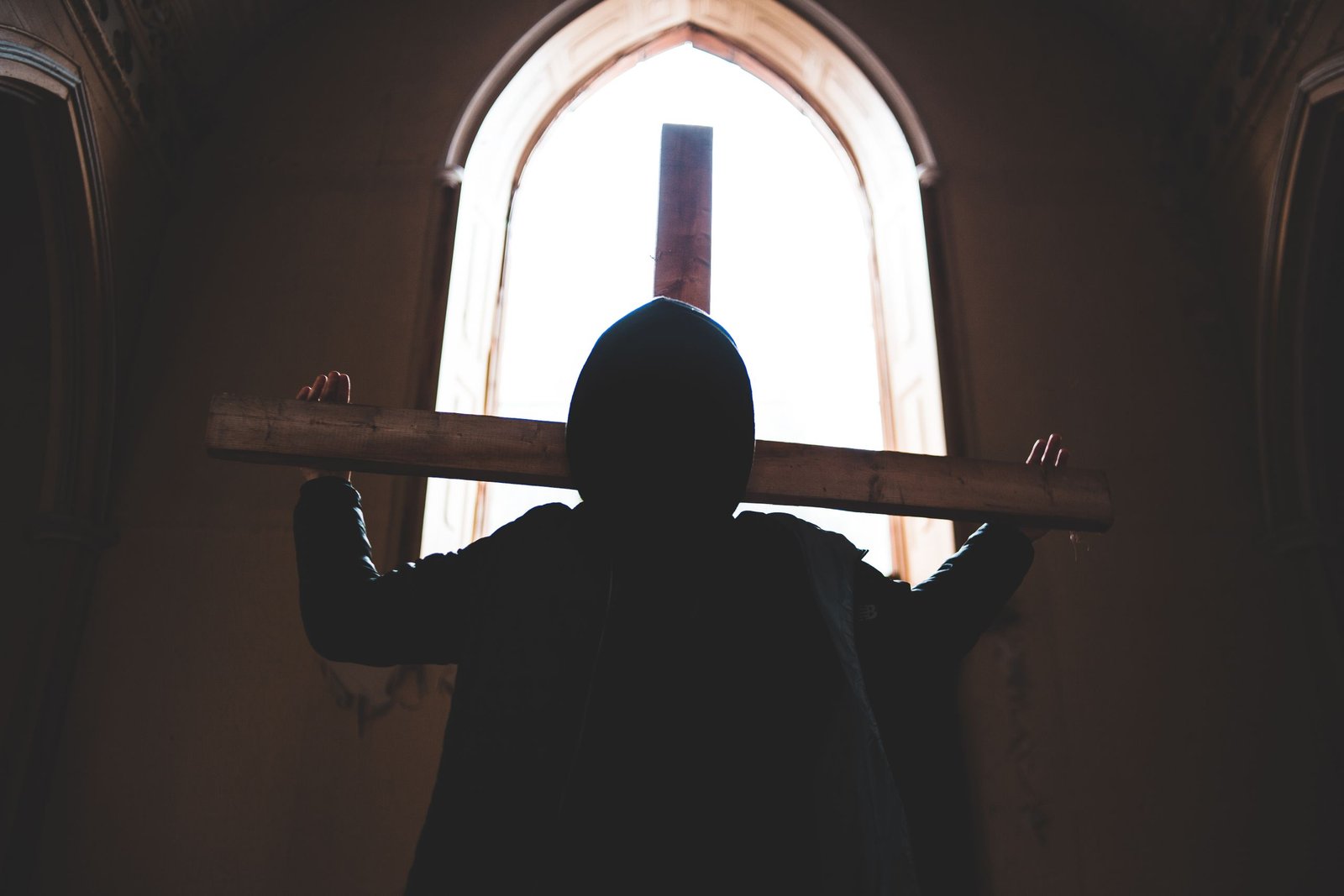
Lay down the heavy cross of terror. Drop the exhausting burden of trying to be pure enough, good enough, or quiet enough to earn God’s love. Step out into the warm, open air of your own spiritual freedom. Your soul is free, your voice is sacred, and your heart is finally, truly home.
Book a 15-minute free Call with me – Learn to recognize and transform the negative patterns that may be holding you back and use them for your good. https://gloriaogunbadejo.com/15-minutes-call/